Published: July 8, 2026
Category: Methodology
Read Time: 10 min read
[!NOTE] Editorial: Rankings below synthesize the U.S. Foreign Service Institute (FSI) difficulty categories and peer-reviewed research on linguistic distance—not influencer listicles. FSI hour estimates assume intensive classroom study (~25 hours/week) for adult learners with strong aptitude. Your timeline will vary with motivation, prior languages, and study design. This article is not a guarantee of fluency timelines.
What “easiest” actually means
If you grew up speaking English, some languages are structurally closer to what your brain already knows. That closeness shows up as:
- Shared vocabulary (cognates from Germanic roots or Norman French / Latin influence on English)
- Familiar alphabet (Latin script)
- Overlapping grammar patterns (word order, lack of case systems, simpler verb paradigms at beginner level)
The most cited institutional benchmark is the FSI language difficulty scale. For native English speakers, Category I languages are estimated at roughly 24–30 weeks (600–750 class hours) to reach general professional speaking and reading proficiency (ILR Level 3). Category IV–V languages such as Arabic, Mandarin, Japanese, and Korean are estimated at roughly 88 weeks (~2,200 hours).
Large-scale research backs the broad picture. Schepens, van Hout, and Jaeger (2020) analyzed speaking proficiency data from tens of thousands of adult learners of Dutch and found that a learner’s native language accounts for a substantial share of outcome variance—much of it explainable by lexical, morphological, and phonological similarity to the target language (Cognition).
Cysouw (2013) modeled FSI difficulty ratings and found that whether a language is Germanic vs. non-Germanic is among the strongest predictors of ease for English speakers—stronger than many geographic factors (PDF).
One nuance worth stating up front: closeness is not always a free pass. Gil (2025) shows that when learners must restructure L1 habits rather than simply add new words, typologically similar languages can still trip people up. Cognates help—but false friends and pronunciation traps are real.
The Top 10 (FSI Category I)
All ten languages below sit in FSI Category I for English speakers. We rank them within that band by Germanic proximity, grammar transparency, cognate payoff, and typical pronunciation friction—not by claiming one is officially “half as hard” as another.
1. Norwegian
- Germanic family: Same broad branch as English; Cysouw’s models flag Germanic membership as a major ease factor.
- Simple verb morphology at beginner level (one present-tense form per verb is a common teaching point).
- SVO word order close to English—Kan du hjelpe meg? maps cleanly onto “Can you help me?”
- High everyday lexical overlap (seasons, common nouns).
- FSI Category I (~600–750 class hours in intensive training).
World Cup 2026: learn ro before you learn grammar
With Norway back at the FIFA World Cup for the first time since 1998, their supporters have gone viral with the Viking row (vikingro): fans sit in rows like a longship crew, pull imaginary oars to a drumbeat, and chant “Ro!”—the Norwegian word for “row” (imperative of å ro). It sounds almost identical to English row, and it means the same thing. That is Norwegian difficulty in miniature: one syllable, instant meaning, zero flashcard required.
The ritual was developed by Norway’s supporter culture ahead of the tournament—ESPN and The Local Norway trace it to fan leader Ole Frøystad, who wanted a Viking-themed chant that would travel. It has since spread from stadiums to subway platforms, offices, and even the pitch—Norway’s players joined in after their win over Brazil.
Watch the moment: Norway celebrate their win over Brazil — Viking row chant (YouTube)

Try it yourself: sit in a row, mime rowing, and shout “Ro!” on each stroke. Then open LingoCapture and scan something in your room—you are already thinking like a Norwegian learner.
2. Dutch
- Closest major national language to English in everyday vocabulary (water, boek / book, appel / apple).
- West Germanic structure without German’s case system.
- Latin alphabet—no new writing system.
- FSI Category I, though identical spellings often have different pronunciations (rat sounds unlike English “rat”).
- Regional utility across the Netherlands, Belgium, and as a bridge to Afrikaans.
Oranje at the World Cup: Links! Rechts!
The Netherlands are at the 2026 World Cup, and their travelling support is defined by the Oranje fan walks and the party anthem “Links Rechts”—fans link arms and jump in unison to the left and right while shouting the directions aloud. AS and OneFootball describe it as the unofficial soundtrack of Dutch games at this tournament; retired legend Clarence Seedorf has even led the crowd in it.
Your first two Dutch lessons are built into the dance:
- links = left
- rechts = right
Both are West Germanic cousins of English (left / right), and you will hear them shouted thousands of times before anyone explains verb conjugation.
Watch the orange wall in motion: Netherlands fans dance in the streets — Links Rechts fan march (YouTube)
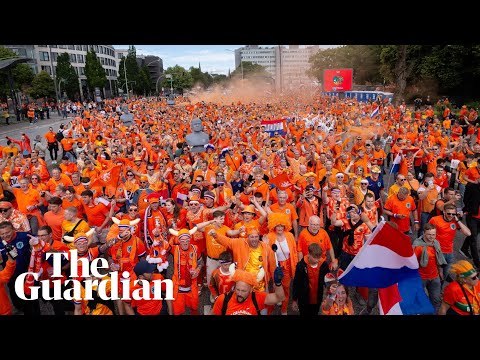
This clip was filmed in Hamburg during Euro 2024, when tens of thousands of Dutch supporters marched to the stadium—the same Oranje ritual that has returned at World Cup 2026 fan walks across U.S. host cities. Learn links and rechts, then scan something orange in your kitchen with LingoCapture.
3. Afrikaans
- Descended from Dutch with very high vocabulary overlap with English and Dutch.
- No grammatical gender and relatively regular grammar compared with Dutch or German.
- Germanic advantage for English speakers on the same principles as Dutch and Norwegian.
- Smaller global speaker base, but an accessible entry point into Germanic languages.
- FSI Category I.
4. Spanish
- Romance language, but English carries heavy French/Latin lexical influence after the Norman Conquest—so Romance cognates are everywhere in educated English.
- Cognate advantage in the lab: Casaponsa et al. (2020) found cognate translations are learned and remembered more easily than non-cognates in L2 word-learning tasks (Behavioral Sciences).
- Mostly phonetic spelling once core rules are learned.
- Massive learner ecosystem (media, travel, community).
- FSI Category I.
5. Italian
- Transparent spelling-to-sound relative to French or English irregularity.
- Romance cognates via Latin roots (information → informazione).
- Predictable phoneme patterns build early speaking confidence.
- Regular beginner verb patterns (complexity increases at intermediate levels).
- FSI Category I.
6. Portuguese
- Structurally close to Spanish; many learners benefit from transfer if they know either language.
- Romance cognate pool for English speakers.
- Global reach (Brazil, Portugal, Lusophone Africa).
- Pronunciation (nasal vowels) is often the first hurdle—not core grammar distance.
- FSI Category I.
7. Swedish
- North Germanic with the same broad “Scandinavian advantage” as Norwegian.
- No verb conjugation by person in the way Romance languages require at early stages.
- English-like sentence scaffolding for basic communication.
- Mutual intelligibility benefits across Nordic languages.
- FSI Category I.
8. French
- Enormous shared academic and everyday vocabulary with English (Norman French legacy).
- Familiar alphabet; Romance grammar is pattern-based once basics click.
- Pronunciation and spelling gap is the main cost—not lack of cognates.
- Global utility (diplomacy, Africa, Canada, EU institutions).
- FSI Category I despite pronunciation work.
9. Danish
- Germanic + Category I on paper.
- Grammar simpler than German (no case system like German).
- Spoken pronunciation is the trap—written Danish looks friendly; spoken Danish is notoriously opaque, which is why many practitioners rank it below Norwegian and Swedish in practice.
- Useful in Denmark and parts of the Nordic region.
- FSI Category I.
10. Romanian
- The outlier Romance language in Eastern Europe—still FSI Category I.
- Latin alphabet and Romance core vocabulary help English speakers.
- More Balkan and Slavic influence than Western Romance → less instant recognition than Spanish or Italian.
- Smaller learner market, but structurally closer than Slavic or East Asian languages.
- Often the hardest of the “easy ten” within Category I.
Why German is not on this list
English speakers often assume German should top the chart. It shares thousands of cognates—but the FSI places German in Category II (~900 hours), not Category I. Atlas Obscura’s summary of the FSI map notes that German grammar (gender, case, verb placement, conjugation) outweighs vocabulary overlap for time-to-proficiency (article). German is absolutely learnable; it is simply not in the same institutional “easiest” band as Dutch or Spanish.
The cognate advantage (and its limits)
Romance and Germanic languages give English speakers a head start—but cognates must be recognized, not assumed.
- Otwinowska (2015) documents that even transparent cognates are not always spotted spontaneously by L2 learners without instruction (Cognate Vocabulary in Language Acquisition and Use, Multilingual Matters).
- Lubliner and Hiebert (2011) show English–Spanish cognates are a major source of academic vocabulary—but teachers still need explicit cognate strategy work (Bilingual Research Journal).
- False friends (actual in Spanish, gift in German) punish guesswork.
Takeaway: cognates are fuel, not autopilot.
How to learn any of these ten languages well
Research from the last fifteen years converges on a few principles that beat “download an app and hope.”
1. Context beats lists
Bilgin, Tokel, and colleagues (2019) showed that contextual vocabulary exploration in a mobile-supported situated learning environment can be enhanced when tasks are authentic and tied to place (Journal of Educational Computing Research). Godwin-Jones (2018) argues directly for contextualized vocabulary learning in computer-assisted environments—linking words to situations, not isolated flashcard rows.
2. Micro-sessions + spacing beat cramming
Chukharev-Hudilainen and Klepikova (2016) ran a double-blind CALL study and found that ~three minutes per day of computer-based spaced repetition activities tripled long-term vocabulary retention relative to control conditions—without changing the rest of classroom pedagogy (CALICO Journal).
A web-application study in Frontiers in Psychology (spacing, feedback, and testing conditions) confirmed that spacing between sessions, retrieval practice, and feedback improve vocabulary learning efficiency in digital tools (PMC).
3. Embodied and hands-on use sticks
A 2024 quasi-experimental study on hands-on content-language integrated learning reported stronger vocabulary and procedural gains when language was embedded in active, contextual tasks rather than detached drills (Humanities and Social Sciences Communications).
4. AR and mobile environments can support situated learning
Meta-analytic work on AR/VR in museum and mobile learning finds moderate-to-strong effects on learning outcomes when technology is tied to meaningful tasks—not novelty alone (see syntheses cited in AR museum-learning reviews, 2021–2022). The pattern: environment + retrieval + feedback, not screens for their own sake.
Where LingoCapture fits (contextual micro-lessons)
LingoCapture is built around the stack above—not around “infinite streaks” or generic decks.
| Principle | What research favors | What LingoCapture does |
|---|---|---|
| Context | Words tied to place, task, and object (Bilgin et al., 2019; Godwin-Jones, 2018) | Scan real objects, signs, and menus; save to LingoDex |
| Micro-learning | Short, frequent sessions; spacing over time (Chukharev-Hudilainen & Klepikova, 2016) | Feed serves short lesson-style review from your captures |
| Retrieval + production | Testing and feedback beat passive re-reading (spacing meta-study, PMC) | Chat and Arcade move you from recognition to use |
| Personal corpus | Learner-selected referents support retention | Your vocabulary is built from your world—not a textbook chapter you will never revisit |
Practical four-week starter plan (works for any language on this list):
- Week 1: Scan five real objects per day (kitchen, commute, gym) and save them to LingoDex.
- Week 2: Review Feed micro-lessons 5–10 minutes daily—spacing, not marathons.
- Week 3: Run one Chat scenario tied to your scans (café order, transit, grocery).
- Week 4: Play one Arcade session, then revisit your weakest saved words.
For Romance picks (Spanish, French, Italian, Portuguese, Romanian), lean into cognates early—but anchor every word to a real context so you do not build “textbook Spanish” that fails in a real bakery. For Germanic picks (Norwegian, Dutch, Afrikaans, Swedish, Danish), exploit word-order familiarity, but drill pronunciation deliberately—especially for Danish and Dutch false friends.
Pick your language, then pick your method
The ten languages above are not “easy” in the sense of effortless. They are structurally closer to English by the best institutional and quantitative measures we have. What separates learners who progress from those who stall is usually method: context, spacing, retrieval, and production—not which app icon glows brightest on the home screen.
Download LingoCapture, choose one of these ten, and start with what is already in front of you.
References
- U.S. Foreign Service Institute. Language learning difficulty for English speakers (Category I–V hour estimates). Summarized at Wikibooks.
- Schepens, J., van Hout, R., & Jaeger, T. F. (2020). Big data suggest strong constraints of linguistic similarity on adult language learning. Cognition, 201, 104700. https://doi.org/10.1016/j.cognition.2020.104700
- Cysouw, M. (2013). Predicting language-learning difficulty. In World Languages: Constellations (working paper). http://cysouw.de/home/articles_files/cysouwPREDICTING.pdf
- Gil, H. (2025). Restructuring vs. development: When typological closeness does not facilitate L2 acquisition. https://doi.org/10.17863/CAM.122221
- Casaponsa, A., Antón, E., Pérez, A., & Duñabeitia, J. A. (2020). Better to be alone than in bad company: Cognate synonyms impair word learning. Behavioral Sciences, 10(8), 123. https://doi.org/10.3390/bs10080123
- Otwinowska, A. (2015). Cognate Vocabulary in Language Acquisition and Use: Attitudes, Awareness, Activation. Multilingual Matters.
- Lubliner, S., & Hiebert, E. H. (2011). An analysis of English–Spanish cognates as a source of general academic language. Bilingual Research Journal, 34(1), 76–93.
- Bilgin, C. U., Tokel, S. T., & others (2019). Facilitating contextual vocabulary learning in a mobile-supported situated learning environment. Journal of Educational Computing Research. https://doi.org/10.1177/0735633118779397
- Godwin-Jones, R. (2018). Contextualized vocabulary learning. Language Learning & Technology, 22(3), 1–19.
- Chukharev-Hudilainen, E., & Klepikova, T. A. (2016). The effectiveness of computer-based spaced repetition in foreign language vocabulary instruction: A double-blind study. CALICO Journal, 33(3), 334–354. https://doi.org/10.1558/cj.v33i3.26055
- Atlas Obscura. See language difficulty of European languages according to the FSI map. https://www.atlasobscura.com/articles/language-difficulty-map
- ESPN (2026). How Norway's "Viking Row" was made, and then took over the World Cup. https://www.espn.com/soccer/story/_/id/49221882/norway-world-cup-viking-row-usa-fans-erling-haaland-martin-odegaard
- The Local Norway (2026). What's the story behind Norway's "row row" football chant. https://www.thelocal.no/20260624/whats-the-story-behind-norways-row-row-football-chant
- AS USA (2026). What are the Dutch fans singing at the 2026 World Cup? “Links Rechts” at Netherlands matches. https://en.as.com/soccer/what-are-the-dutch-fans-singing-at-the-2026-world-cup-links-rechts-can-be-heard-at-all-netherlands-matches-f202606-n/
- OneFootball (2026). What is “Links Rechts”? Iconic Dutch chant returns at the World Cup. https://onefootball.com/en/news/what-is-links-rechts-iconic-dutch-chant-returns-at-the-world-cup-43012752
Ready to start with a language on this list? Download LingoCapture free on the App Store or Google Play.
Interested in contextual capture and spaced review? Download LingoCapture free on iOS and Android.